What If Magic Only Had Four Colors? – Intro

Where we're going, we don't need Blue cards...

Everyone has always wondered “What if there was a sixth color in Magic?” Ever since the first InQuest article that spread the rumors of it to it almost being in Planar Chaos, adding another color in Magic is a pretty fun thought experiment.

But completely overdone.

Thanks to my blogging friend Salivanth, who I stole the idea from (He’s a tournament blogger while I’m the design blogger, I will write a tournament post to get him back), he touched on it briefly by looking at an very interesting concept: what if Magic only had four colors? What would change in the game? What color(s) would have countering, and discard, and mana ramping?

I’ll take a look at each of the colors as if they weren’t there and who would get what mechanics (the complete opposite of Purple because what mechanics would each color have to give up?). As a bonus, you’ll get some cards from this hypothetical game. But not everything will be a straight pull to another color as some famous cards would have to be multicolor or have certain mechanics to replicate the missing color’s abilities.

Now, just like my Color Pie Project, each color will get it’s own week to disappear.Fist up, we’re going to see what it would be like without White (This time going around our color wheel not alphabetically). What would happen to the order/chaos battle? The “Good” versus “Evil” battle? Would there even be life gain in the game anymore (Hint: yes).

Just to wet your appetite, here is a famous Black card that would be printed differently if there was no Black: Continue reading “What If Magic Only Had Four Colors? – Intro”

After MaRo – The 2009 State of Design Response

MaRo from UGMadness.net

This is the 5th State of Design that MaRo released since his tenure as Head Magic Designer who is the mouthpiece of Wizards. But this is quite an important one as now, after this amount of time, he has developed a pattern. Before we look at the present (and the “future”), we must look at the past.

MaRo always has goals that he wants to do for design for the upcoming block. This is always an easy task because *shock* they have already designed and close to printing the future block that MaRo is wanting to make goals for. It’s easy to make goals for something you’ve already done. Maybe goal in the traditional sense (the act of throwing, carrying, kicking, driving, etc., a ball or puck into such an area or object), should be replaced with another definition (Synonyms: 1. target; purpose, object, objective, intent, intention. 2. finish). Um, let’s use intent. It’s their intent (goal) to do hit these marks and make them go over well.

Taking a look at the past year’s “goals” there is a pattern going on here (MaRo says humans like patterns). Let’s take a look at them for each year and see what the goals were with what they accomplished:

2005 – Ravnica: City of Guilds Block

1. Institute block design (Have colored pairs throughout the block rather than one set)

2. Design between blocks (Don’t have Ravnica beat up Champions, let them work together)

3. Design and create integration (Create more Spirits!)

2006 – Time Spiral Block

1. Continue with the past goals (Past-present-future, cards that work with multicolor, mix dredge/hellbent with flashback)

2. Embrace the tools of the past (Use old mechanics)

3. Find ways to surprise (Surprise! Psionic Blast is back! Surprise! Wrath of God is now Black! Surprise! Magic is making contraptions!)

2007 – Lorwyn/Shadowmoor Blocks

1. Go back to our roots (Creatures smash and Blue/Black get the best spells)

2. Find innovation that doesn’t shock (Besides that four sets a year thing. Two/two blocks (race-class, friendly hybrid/enemy hybrid))

3. Be all inclusive (Spikes got Faeries/Cryptic Command, Johnnys got hybrid and Timmys got the entire Lorwyn block)

You gotta diversify your bonds!

2008 – Shards of Alara Block

1. Give things more time and space to breathe (The middle set? No new mechanics)

2. Embrace Flavor (5 shards each with their own keyword/theme)

3. Don’t be afraid to diversify (We about to go to war, invest in some nuclear bombs)

2009 – Zendikar Block

1. Explore new areas of design (No set around lands yet? Brilliant!)

2. Bring more resonance to the game (It’s a Trap!)

3. Continue to challenge expectations (Third set? Yeah, it’s big)

What does that mean? Do MaRo’s goals actually mean nothing then just big giant spoilers for the whole block? Is the cake a lie? Continue reading “After MaRo – The 2009 State of Design Response”

Magic Celebrity Commercial – You Like Fallen Empires?

Shut up, fool@
Shut up, fool!

INT – WIZARDS OF THE COAST MEETING ROOM – MORNING

Inside one of the meeting rooms, two members of a marketing company, TIM and CARL get ready to pitch a series of commercials for the Magic: the Gathering brand. Sitting across the room are several managers of Wizards of the Coast and MARK ROSEWATER, head of Magic Design. Tim stands up and smiles.

TIM
Thank you gentlemen for meeting with us today. As you know, Blizzard decided to do some commercials for World of Warcraft with celebrities saying they played the game themselves. Those commercials were wildly successful and anything that we’ve learned is that if it works once, it will work again. We have come to you thinking the same thing: showing celebrities loving your game.

PAUL, one of the Wizards employees nods in agreement.

PAUL
That sounds perfectly reasonable. I’m sure that some of the Pro Tour players would love to be in a commercial.

Carl, sitting to Tim’s right, shakes his head no.

CARL
No, we’re thinking of movie celebrities, that lost of people know. What do William Shatner and Mr. T have in common? They have geek cred. You get someone your core demographic is familiar with,the you can have the geek cred as well.

MARK
When I was working on Roseanne…

TIM
(Cutting him off)
Fascinating story, I’m sure. We’ve already filmed a pair of commercials with a high profile actor who has a ton of geek cred.

Tim picks up a remote and points it at the screen.

TIM
(cont’d)
Let’s watch. Continue reading “Magic Celebrity Commercial – You Like Fallen Empires?”

Design Class – What Would You Pay For a Creature? How About Nothing?

And remember: Keep the Kobold population low. Have your Koblod sprayed or neutered.

Sometimes an idea is so wild, so out there, so insane that at first glance it won’t make sense. You’ll shake it off as insane and think never in a million years would this make sense. But this is exactly the idea that LSK on MTGSalvation came up with. To the message boards!

Here’s the theoretical card:
Minikin – 0
Artifact Creature – Mannequin
1/1
Imagine it were a M10 common, tacked on to the set as-is. Would it break limited formats? Standard? Extended?
It might allow for explosive openings, but that’s balanced by its low power.

Right now in Magic (to M10) there are six 0 casting cost creatures: three of them are Kobolds, and three are artifacts. None of these creatures have a power greater than 1. What would happen if Wizards decided to print a “free” 1/1 creature?

Some people suggested that it should have a drawback like “you can’t play other spells this turn,” or make it Legendary. All of this talk is nice, but it defeats the purpose of the goal. Could a 0-casting cost 1/1 creature see print? After all, we have a 3/3 for GW, a 2/2 for W, why couldn’t there be a 1/1 for 0? Let’s take a look what this entails. Continue reading “Design Class – What Would You Pay For a Creature? How About Nothing?”

Guest Post: Your First Deck is Always Free – Starter Decks to Teach Magic

7th Edtion StarterEditor’s Note: This is a guest post written by Jay Bailey. He’s got a blog called Magic: the Blogging (mtgsalivanth.blogspot.com), and can be found on Twitter (twitter.com/mtgsalivanth. Remember kids, mine is twitter.com/mtgcolorpie). He asked me if he could do a guest post on my blog. My outward voice said, “Of course you may. Having other people want their stuff on my site is an honor.” But my inner voice said, “Awesome, the best kind of writing: when others do it for you.”
Anywho, Jay’s blog focuses more on the tourney aspect of Magic and working on deck lists and that sort of thing (I think this is the first time a decklist will be posted on this site). True Story: A guy came into the local shop (it’s in a mall with other board games/puzzles so half of the shop’s business is other games besides cards) and asked if Magic had any strategy to it. Why couldn’t someone buy all of the cards and put them into a deck? The next day I got this guest post. Enjoy!

It’s happened to all of us. You’re playing Magic, in a store, or in a public place, and someone comes up to you and asks ‘What’s this?’ You answer a well thought-out response, something like: “Magic is a game of strategy. The idea is to outthink your opponent and use your cards well to kill your opponent before he kills you.” They ask if they can play. You say sure…and then remember the only decks you brought today are that crazy combo deck or that tournament-winning deck that’s notoriously hard to play. You go ahead anyway but their eyes start glazing over, and within minutes, you’ve lost them.

So what do we do?

The key is to build a couple of decks that are designed for teaching new players. They don’t need to be expensive or powerful, but they should be tailored to gently introduce aspects of the game to people. Here are the decks I use:

Runeclaw
Still America's #1 Threat

R/G Aggro:

Lands:

2 Terramorphic Expanse
7 Forest
7 Mountain

Creatures:
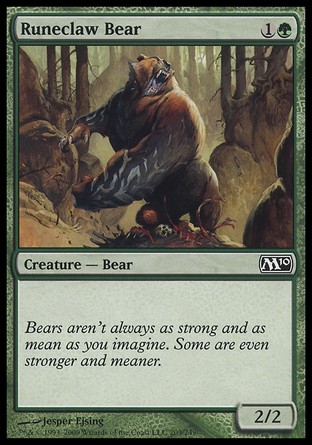
4 Runeclaw Bears
4 Canyon Minotaur
3 Sparkmage Apprentice
3 Centaur Courser
2 Cudgel Troll

Spells:
4 Giant Growth
4 Seismic Strike

Mechanics:

Mana-fixing: The Terramorphic Expanses are there to teach them how to smooth their mana, and pick the color they need.

Sparkmage Apprentice: A big lesson in this deck is using your cards wisely. When a new player first holds back their Sparkmage Apprentice to hit the Merfolk Looter in the U/B deck they know is coming down, they feel like they “Get it” and feel smart for it.

Regenerate: Ignore this for a few games. This will teach players about keeping mana open and how hard it is to kill something that just will not die.

Removal: Seismic Strike is fairly easy to understand. You can use it on any creature in the U/B deck if you have enough mana, and it’s easy to count.

Giant Growth: This card has varying degrees of complexity. First they’ll use it at any opportunity. Then they’ll save it. Finally, they’ll learn to use it in response to your blocking, and they’ll have mastered this deck and it’s time to move on to the other deck. Continue reading “Guest Post: Your First Deck is Always Free – Starter Decks to Teach Magic”